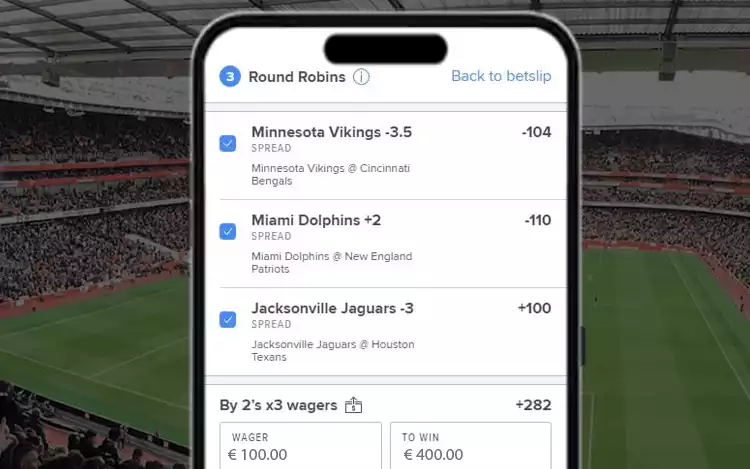
A round robin bet is one of those terms most bettors have heard of but rarely use correctly. It sits in the same family as Trixies and Patents, but it has one key difference: it includes single-stake-about bets, which change both the cost and the potential return entirely. If you understand that, you understand the entire bet.
This guide breaks round robins down in plain terms, what they are, how they are built, and when they are actually worth using.
What Is a Round Robin Bet?
A round robin uses three selections and turns them into 10 bets:
- 3 doubles
- 1 treble
- 6 single-stakes-about (up-and-down) bets
The purpose is simple: instead of relying on all three selections winning, as you would with a treble, you create several different ways to generate a return. You also commit to a higher stake, because you are covering more combinations.
BetMaze Offer
Advertiser Disclosure: At Gambling Zone, we may earn a referral commission if you sign up through links on our site. This helps support our work and does not influence our independent reviews or ratings. Learn more about our review criteria.
How a Round Robin Is Structured
Imagine you are betting on three horses:
- Horse A
- Horse B
- Horse C
A round robin produces the following:
Doubles
Horse A + Horse B
Horse A + Horse C
Horse B + Horse C
Treble
Horse A + Horse B + Horse C
Single-Stakes-About (Up-and-Down) Bets
Each pair of horses is also linked through up-and-down single-stakes-about bets. These are two connected singles.
Example with A and B:
- A wins → returns go as a single on B
- B wins → returns go as a single on A
- The same applies to A ↔ C and B ↔ C.
That creates six up-and-down bets in total, and these are the reasons the stake multiplies quickly. They also give the round robin more ways to generate returns when your selections win in sequence.
Single-Stakes-About (Up-and-Down) Explained
You do not need to overthink this. They are simply linked singles that trigger when one of your horses wins. They are the reason the round robin reaches 10 bets rather than four like a Trixie.
All you really need to know is:
- They increase the total stake
- They can add extra returns when your winners land in the correct order.
How Much Does a Round Robin Cost?
Because the bet contains 10 individual components, the total cost is: Stake per bet × 10
Examples:
- £1 per bet → £10 total stake
- £2 per bet → £20 total stake
- £5 per bet → £50 total stake
This is where many bettors go wrong. They enter a stake “per bet” on the slip without noticing that the round robin multiplies it by ten. Always treat the round robin as a 10-unit bet, not as a single stake. This can significantly reduce your bankroll. At Gambling Zone, we always recommend only betting what you can afford, so bear it in mind.

What a Round Robin Can Return
What a Round Robin Can Return
A round robin does not require all three selections to win. You can return money through:
- Any two winners (doubles)
- Up-and-down chains producing linked singles
- All three winners (treble + doubles + several up-and-downs)
However, the outcome varies heavily based on the prices involved.
Two short-priced winners may give you only a small profit.
Two mid-range winners can perform well.
Three winners at reasonable odds can produce a substantial return because multiple parts of the bet land. There is no guaranteed pattern; the structure simply offers more ways to be paid. The best betting sites will display your potential returns in the bet slip at any stage of your bet.
Example of a Round Robin Bet
Take three horses:
- Horse A at 2/1
- Horse B at 3/1
- Horse C at 5/2
A round robin uses 10 bets, so at £1 per bet, your total stake is £10.
If All Three Win
You land the doubles, the treble, and all the up-and-down bets. With these prices, the total return is around £150 from a £10 stake.
If Two Win
You will still hit the relevant double and the up-and-down bets between those two horses, which delivers a clear profit even without the treble.
If Only One Wins
One winner on its own does not yield any results.
Up-and-down bets only pay if the winning horse triggers a second stake and that second horse also wins. So with only one winner, the sequence cannot be completed.
Round Robin vs Trixie vs Patent
Here is the simple comparison:
Trixie: 4 bets
Includes: 3 doubles + 1 treble
Patent: 7 bets
Includes: 3 singles + 3 doubles + 1 treble
Round Robin: 10 bets
Includes: 3 doubles + 1 treble + 6 up-and-down single-stakes-about bets
A round robin is essentially a Trixie with the six up-and-down bets added on top. This increases the overall stake and can make the returns more volatile, depending on how your selections perform.
When Does a Round Robin Make Sense?
Only in specific scenarios.
When You Rate All Three Selections
- The structure depends on each horse having a fair chance to compete.
- If one is a clear weak link, the up-and-down chains involving it become less efficient.
When Mid-Range Prices Are Involved
- Round robins work well when your horses are in the evens to 4/1 type of range.
- Too short, and returns are restricted.
- Too big, and outcomes swing wildly.
When You Want More Protection Than a Treble
- A treble dies with a single loser.
- A round robin still gives you doubles and up-and-down returns.
When You Can Afford the Total Stake
- Because it’s a 10-bet structure, you should only use round robins when the combined cost fits your staking plan.
When a Round Robin Is Not Suitable
- When you are covering favourites at small odds
- When you want a simple low-stake multiple (treble is cleaner)
- When one of your selections is speculative
- When you want a big potential payout from a tiny outlay
- When you haven’t calculated the total stake
Round robins are a tool, not a default choice. Only use them when the structure genuinely fits the prices and the situation.